How Mandi Prices Work in India: APMC, Modal Prices & Daily Rates
Mandi prices in India are market prices reported from agricultural markets where farmers, traders and buyers transact in commodities. These prices can vary by mandi, commodity, quality, variety, arrivals and local demand.
Government platforms such as Agmarknet publish daily price and arrival information from agricultural markets across India, while e-NAM provides an electronic marketplace and price-discovery infrastructure connecting agricultural markets.
A typical mandi price report may show:
- Minimum price
- Maximum price
- Modal price
- Commodity
- Variety
- Market/mandi
- Arrivals
- Date of reporting
Among these numbers, the modal price is particularly useful because it represents the price at which the largest volume of transactions is reported to have occurred in a market during the reporting period.
However, a mandi’s modal price is not necessarily the exact price every farmer receives.
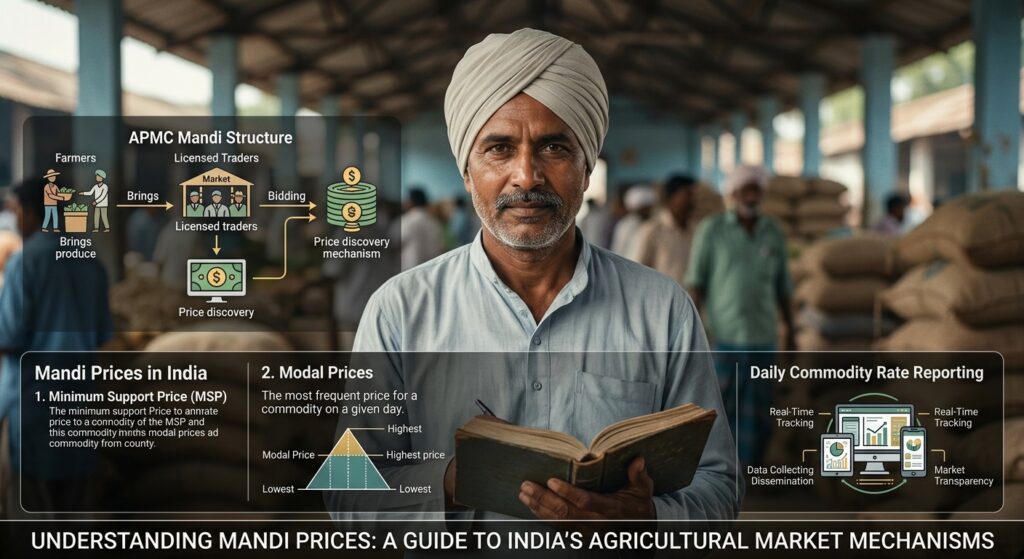
What Is a Mandi?
In India, a mandi is an agricultural market where farmers and other market participants buy and sell agricultural commodities.
Historically, many agricultural markets have operated under state-level Agricultural Produce Market Committee (APMC) frameworks.
The basic purpose of a regulated agricultural market is to provide an organised marketplace where agricultural produce can be brought for sale and transactions can take place under applicable market rules.
Depending on the state and commodity, the market may involve:
- Farmers
- Commission agents
- Traders
- Wholesalers
- Buyers
- Market committees
- Other licensed participants
The exact structure varies between states because agricultural marketing is substantially regulated at the state level.
What Does APMC Mean?
APMC stands for Agricultural Produce Market Committee.
APMCs are associated with regulated agricultural markets established under state agricultural marketing laws.
The framework was developed to create organised marketplaces for agricultural produce and provide rules governing market transactions.
However, India does not have one identical APMC system operating in exactly the same way in every state.
Different states have different laws, market structures, commodities covered and operational arrangements.
That distinction is important when interpreting mandi data.
How Does a Mandi Transaction Work?
A simplified agricultural market transaction can look like this:
Farmer brings produce
↓
Produce enters the mandi
↓
Quality/variety is identified
↓
Buyers assess the produce
↓
Bidding or negotiation takes place
↓
A transaction price is established
↓
The transaction contributes to market price reporting
The actual process varies by commodity, market and state.
A farmer may therefore encounter several different prices for the same commodity during a trading day.
Why Does the Same Commodity Have Different Prices?
Suppose two farmers bring wheat to the same mandi.
Their wheat may differ in:
- Quality
- Moisture
- Variety
- Grade
- Cleanliness
- Size
- Demand
Consequently, buyers may offer different prices.
This is one reason mandi price reports generally provide a minimum, maximum and modal price, rather than presenting one number as the universal value of every transaction.
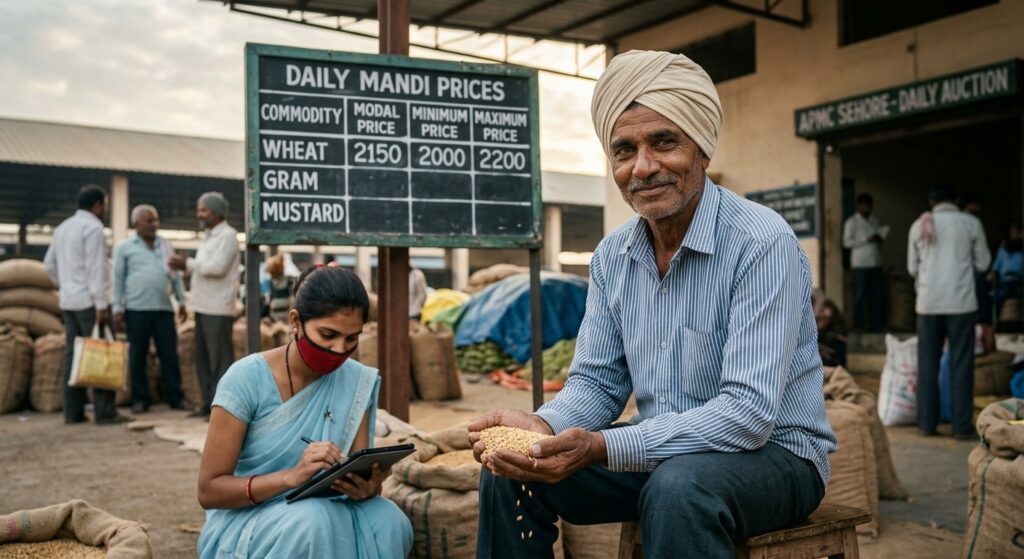
What Is the Minimum Mandi Price?
The minimum price represents the lowest reported transaction price for the specified commodity, variety and market during the reporting period.
For example:
| Price Type | Example |
|---|---|
| Minimum | ₹2,100/quintal |
| Maximum | ₹2,650/quintal |
| Modal | ₹2,450/quintal |
The ₹2,100 figure does not mean every farmer received ₹2,100.
It indicates that the lowest reported price in that particular reporting set was around that level.
What Is the Maximum Mandi Price?
The maximum price is the highest reported transaction price for the specified commodity and market during the relevant reporting period.
Again, this doesn’t mean every farmer received the maximum.
The highest price may correspond to produce with:
- Better quality
- Better grade
- Stronger buyer demand
- Specific variety
- Different transaction circumstances
Therefore, looking only at the maximum price can create an unrealistic expectation about what a typical farmer can obtain.
What Is the Modal Price?
The modal price is one of the most useful numbers in mandi reporting.
In simple terms, it represents the price at which the largest volume of transactions is reported to have taken place for the specified commodity in the market during the reporting period.
For example:
| Reported Price | Value |
|---|---|
| Minimum | ₹2,100 |
| Maximum | ₹2,650 |
| Modal | ₹2,450 |
If you want a quick indication of the price around which the bulk of market activity occurred, the modal price is generally more informative than simply looking at the maximum.
Why Modal Price Matters to Farmers
Imagine a farmer sees:
Maximum price: ₹3,000/quintal
It may be tempting to assume:
“I can sell my crop for ₹3,000.”
But that may not be realistic.
If the modal price is:
₹2,650/quintal
then the market’s most common transaction level may be considerably lower than the headline maximum.
This is why farmers and traders should examine minimum, maximum and modal prices together.
What Does “Arrival” Mean in Mandi Data?
Arrival generally refers to the quantity of a commodity arriving at the market during the reporting period.
For example:
| Commodity | Arrival |
|---|---|
| Wheat | 1,250 tonnes |
| Onion | 800 tonnes |
| Tomato | 420 tonnes |
Arrivals matter because supply can influence market prices.
When large quantities of a commodity arrive at a market, increased supply can put downward pressure on prices if demand does not increase correspondingly.
When arrivals are low while demand remains strong, prices can move higher.
However, the relationship isn’t automatic because weather, quality, storage, demand, transportation and regional supply also matter.
Why Arrivals and Prices Should Be Viewed Together
Consider two hypothetical days.
Day 1
Arrivals: 500 tonnes
Modal price: ₹2,800/quintal
Day 2
Arrivals: 1,500 tonnes
Modal price: ₹2,500/quintal
The increase in arrivals coincides with a lower modal price.
That may suggest increased market supply contributed to the decline.
But this is only an example.
A real market can be influenced by many variables simultaneously.
What Is Agmarknet?
Agmarknet is a Government of India agricultural marketing information system that provides market-related information, including commodity prices and arrivals.
The current Agmarknet platform provides a Daily Price and Arrival Report and market-wise price and arrival information.
This is important because it provides a central digital source through which users can access agricultural market information.
What Is e-NAM?
e-NAM, or the National Agriculture Market, is a pan-India electronic trading platform intended to create a more integrated agricultural market.
The official e-NAM platform provides access to live price information and also links users with Agmarknet-related price information.
e-NAM is therefore different from simply being a website that publishes mandi prices.
Its broader purpose involves electronic market integration and price discovery.
Agmarknet vs e-NAM
These two names are sometimes confused.
| Feature | Agmarknet | e-NAM |
|---|---|---|
| Main purpose | Agricultural market information | Electronic agricultural marketplace |
| Price information | Yes | Yes |
| Arrival information | Yes | Related market information |
| Market integration | Information-focused | Stronger electronic market integration |
| Government platform | Yes | Yes |
Both are important parts of India’s agricultural market information ecosystem.
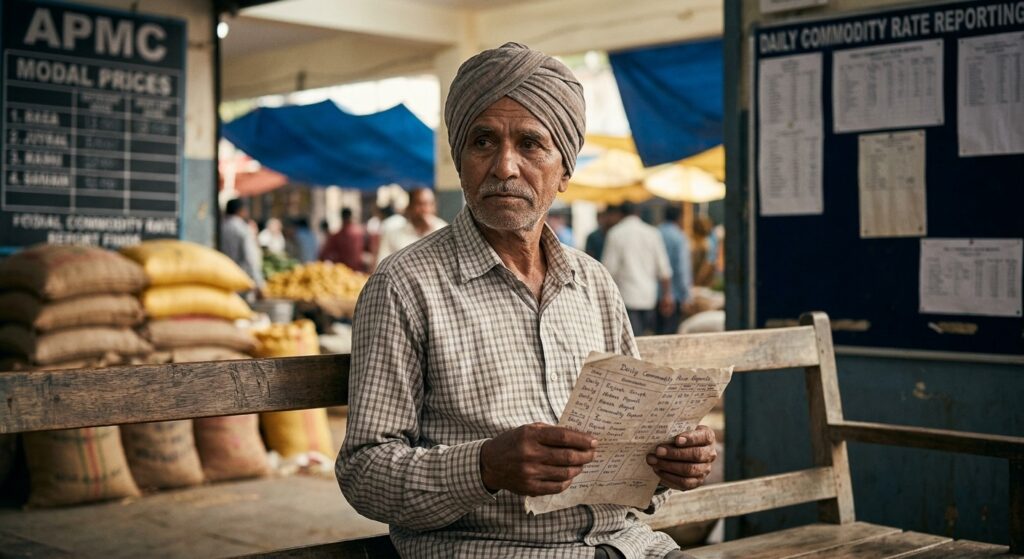
How Daily Mandi Prices Are Reported
A simplified reporting process is:
Agricultural market transaction
↓
Market-level data collection
↓
Commodity and variety identification
↓
Price and arrival information recorded
↓
Data transmitted to reporting systems
↓
Government market information platforms
↓
Farmers, traders and consumers access the information
The exact data collection and reporting procedures can vary by state and market.
Why Mandi Prices Can Be Delayed
A mandi price shown online is not necessarily a live tick-by-tick trading price.
There can be a gap between:
Physical transaction
and
Digital publication
Reasons can include:
- Market reporting schedules
- Data validation
- Transmission delays
- Updates from individual markets
- Different operating hours
Agmarknet itself identifies its information as daily price and arrival reporting.
Therefore, users should always check the date and reporting period attached to a price.
Why Mandi Prices Differ Across India
The same commodity can have significantly different prices in different markets.
For example:
| Market | Commodity | Modal Price |
|---|---|---|
| Mandi A | Onion | ₹2,400 |
| Mandi B | Onion | ₹2,850 |
| Mandi C | Onion | ₹2,200 |
Possible reasons include:
- Local supply
- Local demand
- Quality
- Variety
- Transportation costs
- Seasonal production
- Weather
- Storage availability
- Regional consumption
Therefore, a national average price may be less useful to a farmer than the price at a nearby mandi.
Why Commodity Variety Matters
A common mistake is comparing prices without checking the variety.
For example, “onion” isn’t necessarily one uniform product.
Different varieties can have different:
- Quality
- Size
- Shelf life
- Consumer demand
- Production regions
The same principle applies to many agricultural commodities.
When comparing mandi prices, check:
Commodity + variety + market + date
rather than commodity name alone.
Why Quality Affects the Price
Agricultural commodities are not perfectly identical.
Two lots of tomatoes can have different:
- Size
- Colour
- Ripeness
- Damage
- Moisture
- Shelf life
A buyer may therefore pay more for one lot than another.
This explains why a mandi can report a range of prices on the same day.
Why Farmers Shouldn’t Rely on One Mandi Price
A farmer deciding where to sell produce should ideally compare several factors:
- Nearby mandi prices
- Modal price
- Maximum and minimum prices
- Arrival volume
- Transportation cost
- Commission or market charges
- Produce quality
- Expected demand
- Storage options
The highest reported mandi price isn’t automatically the most profitable option.
Example: Comparing Two Mandis
Suppose a farmer has 100 quintals of a crop.
Mandi A
Modal price: ₹2,700/quintal
Transport: ₹10,000
Approximate gross value:
100 × ₹2,700 = ₹2,70,000
After ₹10,000 transport:
₹2,60,000
Mandi B
Modal price: ₹2,800/quintal
Transport: ₹25,000
Gross value:
100 × ₹2,800 = ₹2,80,000
After transport:
₹2,55,000
Despite having a higher mandi price, Mandi B could produce a lower net return.
This demonstrates why price alone isn’t the same as profitability.
How Weather Can Affect Mandi Prices
Weather is one of the major factors influencing agricultural markets.
Heavy rain, drought, floods, heat waves and unseasonal weather can affect:
- Crop production
- Crop quality
- Harvest timing
- Transportation
- Market arrivals
- Storage losses
Suppose heavy rainfall damages a vegetable crop.
Supply may decline.
If demand remains relatively stable, prices can increase.
Conversely, a strong harvest can increase arrivals and put downward pressure on prices.
Seasonal Mandi Price Patterns
Many commodities have seasonal production cycles.
A commodity may experience:
Harvest season → higher arrivals → potential price pressure
followed by:
Lower arrivals → reduced supply → potential price support
But these patterns aren’t guaranteed.
Government policies, imports, exports, weather, storage and consumer demand can change the market outcome.
How Government Policies Can Influence Mandi Prices
Agricultural markets can also be influenced by government decisions.
Examples include:
- Minimum Support Price (MSP)
- Procurement
- Import policies
- Export restrictions
- Stock limits
- Subsidies
- Buffer stocks
MSP deserves special attention because it is often misunderstood.
Is Mandi Price the Same as MSP?
No.
MSP and mandi price are different concepts.
MSP
A government-announced support price for specified crops.
Mandi Price
The actual market price reported for transactions in a particular agricultural market.
A mandi price can be:
- Above MSP
- Near MSP
- Below MSP
depending on the commodity, market, quality, procurement arrangements and prevailing conditions.
Therefore:
MSP is not the same thing as today’s mandi price.
Why Farmers Check Mandi Prices Daily
Agricultural prices can change quickly.
Daily price information can help farmers monitor:
- Current market conditions
- Price trends
- Nearby market differences
- Arrival changes
- Demand conditions
However, a single day’s price shouldn’t automatically determine a major selling decision.
Looking at a multi-day or multi-week trend can provide more context.
How to Read a Mandi Price Dashboard
When you open a mandi price report, follow these steps.
Step 1: Select the commodity
For example:
Potato
Step 2: Check the variety
Different varieties may have different prices.
Step 3: Select the market
Choose the relevant mandi.
Step 4: Check the date
Make sure you’re looking at the latest available reporting date.
Step 5: Compare minimum, maximum and modal
Don’t rely on just one number.
Step 6: Check arrivals
Large changes in arrivals can help explain price movements.
What Does ₹/Quintal Mean?
Indian agricultural market prices are frequently reported in rupees per quintal.
One quintal equals:
100 kilograms
So if a commodity’s modal price is:
₹2,500/quintal
then the equivalent price is approximately:
₹25/kg
This simple conversion can make mandi data easier for consumers to understand.
Mandi Price vs Retail Price
Another important distinction is:
Mandi price is not the same as retail price.
Suppose potatoes are trading at:
₹2,000/quintal
That equals:
₹20/kg
But consumers may see potatoes selling for considerably more in a retail shop.
The difference can reflect:
- Transportation
- Sorting
- Storage
- Wholesale margins
- Retail margins
- Losses
- Local operating costs
Therefore, a mandi price should not be directly compared with a supermarket price without considering the supply chain.
How India Real Time Can Simplify Mandi Information
This is where a platform such as IndiaRealTime can make everyday information easier to access. Top Cities such as Delhi Mumbai Bengaluru Chennai Kolkata Hyderabad Pune Ahmedabad Jaipur and Lucknow.
Government agricultural-market systems contain valuable information, but users may still need to search through different pages, markets, commodities and reporting systems.
IndiaRealTime’s goal is to make useful information easier to discover by bringing mandi prices into a simple, location-focused interface.
A farmer or trader can potentially use the information alongside:
- Weather
- AQI
- Gold rates
- Silver rates
- Panchang
- Currency conversion
This combination is particularly useful because agricultural decisions rarely depend on price alone.
For example:
Mandi price + weather forecast + local conditions
can provide a more useful picture than a price number by itself.
Why Weather and Mandi Data Work Well Together
Imagine a farmer is preparing to harvest a crop.
They may want to know:
1. What is today’s mandi price?
2. Is heavy rain expected?
3. What is the weather over the next few days?
4. Which nearby market is reporting a stronger modal price?
Bringing these information categories closer together can reduce the amount of searching required.
This is part of the broader IndiaRealTime idea:
Put information people need for everyday decisions in one accessible place.
Common Mistakes When Reading Mandi Prices
Mistake 1: Assuming Maximum Price Is the Normal Price
The maximum is the highest reported price, not necessarily what most sellers received.
Mistake 2: Ignoring Modal Price
The modal price can provide a better indication of the most common transaction level.
Mistake 3: Comparing Different Varieties
A commodity name alone isn’t enough.
Mistake 4: Ignoring the Date
A price from several days ago may not represent today’s market.
Mistake 5: Ignoring Transportation Costs
A higher price at a distant mandi doesn’t automatically mean higher profit.
Mistake 6: Confusing Mandi Price With Retail Price
The price paid by a consumer can be substantially different.
Mistake 7: Treating One Market as India’s Market
Agricultural markets are local and regional.
Frequently Asked Questions
What is a mandi price?
A mandi price is a reported market price for an agricultural commodity traded at a particular agricultural market during a specified period.
What is the modal price in a mandi?
The modal price represents the price at which the largest volume of transactions is reported to have occurred for the specified commodity and market during the reporting period.
What is Agmarknet?
Agmarknet is a Government of India agricultural marketing information system that provides market information including commodity prices and arrivals. Its platform provides daily price and arrival reports.
What is e-NAM?
e-NAM stands for National Agriculture Market. It is a pan-India electronic agricultural market platform that provides price information and supports electronic market integration and price discovery.
Is mandi price the same as MSP?
No. MSP is a government-announced support price for specified crops, while mandi price reflects actual market transactions.
Why do mandi prices change every day?
Prices can change because of supply, demand, arrivals, quality, weather, transportation, seasonal production and government or market conditions.
Why are mandi prices different between cities?
Each market has its own local supply, demand, arrivals, quality mix and transportation conditions.
Does the highest mandi price mean farmers will receive that price?
Not necessarily. The maximum is simply the highest reported price in the relevant data. A farmer’s actual transaction price depends on the commodity, quality, variety, buyer and market conditions.
Key Takeaways From Above
- Mandi prices represent agricultural market transaction conditions, not one fixed national price.
- APMCs are associated with regulated agricultural markets under state agricultural marketing frameworks.
- Minimum price represents the lowest reported price.
- Maximum price represents the highest reported price.
- Modal price provides an indication of the price at which the largest volume of transactions occurred.
- Arrivals indicate the quantity of produce reaching the market and can help explain supply conditions.
- Agmarknet provides government agricultural market price and arrival information.
- e-NAM provides an electronic national agricultural market platform and price-discovery infrastructure.
- Mandi prices can differ because of quality, variety, supply, demand, location and transportation costs.
- Mandi price, retail price and MSP are three different concepts.
- Farmers should consider net returns, not simply the highest advertised mandi price.
Conclusion
Mandi prices are one of the most important pieces of market information for India’s agricultural economy.
But a mandi price is more than a single number.
To understand what is really happening in a market, users should look at the commodity, variety, market, reporting date, minimum price, maximum price, modal price and arrivals together.
Government systems such as Agmarknet make this information available through daily price and arrival reporting, while e-NAM contributes to broader electronic agricultural market integration and price discovery.
For farmers, traders and other users, the most useful question isn’t simply:
“What is today’s mandi price?”
It is:
“What is today’s price for my commodity and variety, in the markets I can realistically access, and what does the wider market data tell me?”
That is where modal prices, arrivals and market comparisons become valuable.
IndiaRealTime can help make this information easier to discover by putting mandi rates alongside other location-specific information such as weather and AQI. The goal is not to replace official agricultural market systems, but to make everyday information easier to find, understand and use.
In short: check the date, check the market, check the variety, compare the modal price, look at arrivals—and never assume the maximum price is the price everyone receives.

Want more like this?
Explore Mandi & Agriculture →