Quick Answer
The gold price you see at an Indian jewellery shop is not simply the London gold price converted into rupees. It is the result of several layers of pricing.
A simplified chain looks like this:
Global gold market → LBMA Gold Price / international spot market → USD/INR exchange rate → Indian bullion market → IBJA reference rates → purity adjustment → GST → making charges → local jeweller’s final price
The LBMA Gold Price is an internationally recognised benchmark, quoted in US dollars per troy ounce and set twice daily in London. In India, the India Bullion and Jewellers Association (IBJA) publishes indicative market and retail rates that are widely used as an Indian reference point. The final amount a jewellery customer pays can then be higher because of GST, making charges and other applicable costs.
1. What Is the “London Gold Fix”?
If you’ve searched for Indian gold prices, you may have encountered the phrase “London Gold Fix.”
There is an important historical distinction here.
The old London Gold Fix was replaced in March 2015. The modern benchmark is officially called the LBMA Gold Price. The auction is independently administered by ICE Benchmark Administration (IBA), while the intellectual property for the benchmark is owned by the London Bullion Market Association (LBMA).
So, when discussing today’s gold market, LBMA Gold Price is the correct terminology.
The benchmark is established through an electronic auction involving market participants and is intended to provide a transparent international reference price for gold.

2. How the LBMA Gold Price Is Set
The LBMA Gold Price is set twice every London business day, at:
- 10:30 a.m. London time
- 3:00 p.m. London time
It is quoted in US dollars per troy ounce.
The auction works by matching aggregated buying and selling interest.
If buying interest exceeds selling interest at the proposed price, the price can move higher. If selling interest dominates, the price can move lower.
The process continues until the market reaches a price where the imbalance between buying and selling interest is within the prescribed tolerance.
The resulting price becomes the benchmark.
3. Why Does an International Gold Price Matter to India?
India is a major gold-consuming country, but domestic gold prices are heavily influenced by international gold markets.
Gold is generally traded internationally in US dollars per troy ounce.
Indian consumers, however, buy gold in Indian rupees per gram.
That means the international price must effectively be converted into the Indian market.
Two variables become particularly important:
- International gold price
- USD/INR exchange rate
4. From Dollars Per Ounce to Rupees Per Gram
This is where the pricing process becomes easier to understand.
One troy ounce contains approximately 31.1035 grams.
Suppose, purely as an illustration, that:
International gold price = $3,000 per troy ounce
and:
USD/INR = ₹85
The approximate rupee value would be:
$3,000 × ₹85 = ₹255,000 per troy ounce
Then:
₹255,000 ÷ 31.1035 ≈ ₹8,198 per gram
This is only a simplified conversion.
It is not the final Indian retail gold price.
Import-related costs, domestic market conditions, premiums, taxes, purity and other factors still have to be considered.
5. The Rupee Can Change India’s Gold Price
The relationship between international gold prices and the rupee is extremely important.
Consider two hypothetical situations.
Scenario A: Gold rises, rupee stays stable
If international gold rises from $3,000 to $3,200 per ounce while the exchange rate remains unchanged, the Indian rupee value of gold generally rises.
Scenario B: Gold stays unchanged, rupee weakens
Suppose gold remains at $3,000, but the rupee moves from ₹85 to ₹90 per dollar.
The imported gold becomes more expensive in rupee terms.
This is why Indian gold prices can rise even when the international gold price hasn’t moved dramatically.
6. What Is the Role of IBJA?
The India Bullion and Jewellers Association (IBJA) is an important reference point in India’s bullion market.
IBJA publishes daily market updates and indicative retail selling rates for different gold purities.
For example, its published retail indications include:
- Fine Gold 999
- 22 KT
- 20 KT
- 18 KT
- 14 KT
IBJA explicitly notes that its indicative jewellery rates are published without 3% GST and making charges.
This distinction is important.
The rate you see quoted as a gold rate per gram should not automatically be interpreted as the final amount you will pay for a piece of jewellery.
7. Why 24K, 22K and 18K Gold Have Different Prices
Gold jewellery isn’t always made from 24-karat pure gold.
The commonly encountered purities include:
| Purity | Approximate Gold Content |
|---|---|
| 24K | 99.9% |
| 22K | 91.6% |
| 18K | 75% |
| 14K | 58.5% |
The higher the gold content, generally the higher the underlying gold value per gram.
For jewellery, 22K gold is particularly common in India.
However, a jewellery price depends on more than purity alone.
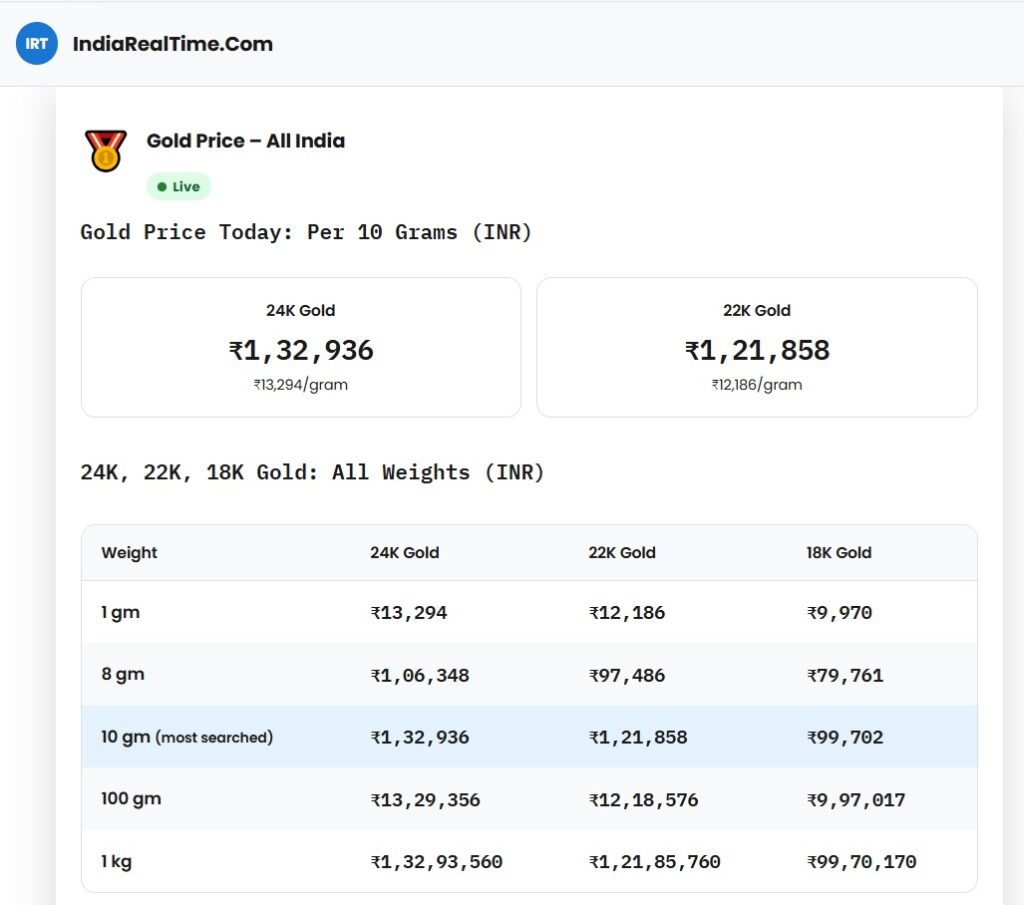
8. Gold Rate vs Jewellery Price
This is one of the most important distinctions for consumers.
Suppose a jeweller advertises:
22K gold: ₹X per gram
That doesn’t necessarily mean a 10-gram necklace will cost:
10 × ₹X
The final bill may include:
- Gold value
- Making charges
- GST
- Stone charges, if applicable
- Other applicable charges
Therefore:
Gold rate ≠ final jewellery price
This is why comparing only the headline gold rate between jewellers can sometimes be misleading.
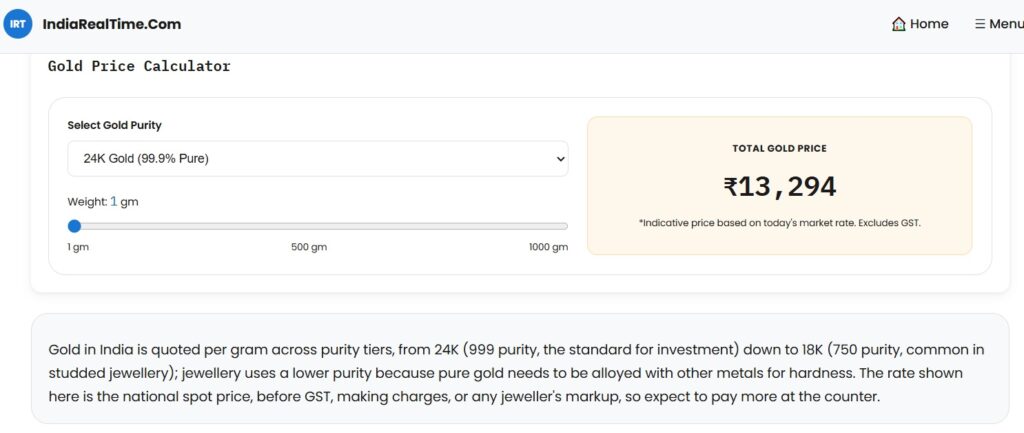
9. What Are Making Charges?
Making charges compensate the jeweller for converting gold into a finished product.
They can depend on:
- Design complexity
- Manufacturing method
- Craftsmanship
- Jewellery type
- Brand
- Retailer
A simple gold chain and an intricate handcrafted necklace may contain the same amount of gold but have very different making costs.
This is one reason two jewellery shops can quote different final prices even when their underlying gold rates are similar.
10. Where Does GST Come In?
GST is another component of the customer’s final bill.
IBJA’s indicative retail rates specifically state that 3% GST and making charges are excluded from the displayed rates.
Therefore, consumers should look at the complete invoice rather than assuming the displayed per-gram gold rate represents the total cost.
11. Why Gold Prices Differ Between Indian Cities
You might notice that gold prices aren’t always identical at every jewellery shop.
Several factors can contribute to differences:
| Factor | Effect |
|---|---|
| International gold price | Major |
| USD/INR exchange rate | Major |
| Domestic bullion market | Major |
| Taxes and duties | Significant |
| Local premiums | Possible |
| Making charges | Significant for jewellery |
| Retailer pricing | Variable |
Two jewellers in the same city can therefore offer different final prices.
12. Why International Events Affect Your Jewellery Bill
Gold is considered a global financial asset as well as a physical commodity.
International developments can affect investor demand.
Important factors include:
- US interest rates
- Inflation expectations
- Geopolitical tensions
- US dollar movements
- Central-bank gold demand
- Global economic uncertainty
- Investment flows
When global investors increase demand for gold, international prices can rise.
That movement can eventually feed into Indian prices.
13. Why Gold Often Gains Attention During Uncertainty
Gold is frequently treated as a safe-haven asset.
When investors become concerned about economic or geopolitical risks, some may increase exposure to gold.
That doesn’t mean gold prices always rise during every crisis. Markets are more complicated than that.
But changes in global risk sentiment can have a significant influence on gold demand and therefore prices.
14. The Complete Gold Pricing Chain
The entire process can be simplified into this model:
Step 1
Global buyers and sellers establish market prices.
↓
Step 2
The LBMA Gold Price provides an internationally recognised benchmark.
↓
Step 3
The USD gold price interacts with the USD/INR exchange rate.
↓
Step 4
Indian bullion-market conditions influence domestic pricing.
↓
Step 5
Indian reference prices such as IBJA rates provide useful market benchmarks.
↓
Step 6
The price is adjusted for gold purity.
↓
Step 7
For jewellery, making charges and applicable taxes are added.
↓
Step 8
The customer receives the final invoice from the jeweller.
15. Why the Price on IndiaRealTime May Differ From Your Jewellery Bill
A website displaying a daily gold price is generally showing a reference market rate, not necessarily the final price of a necklace, ring or bracelet.
For example:
Online reference rate: ₹X/gram
But the jewellery invoice could contain:
Gold value + making charges + applicable GST + other applicable charges
Therefore, IndiaRealTime users should treat gold-rate information as a way to track the market, while the jeweller’s final invoice determines the actual purchase cost.
16. How IndiaRealTime Can Help Gold Buyers
For someone planning to buy gold, monitoring the rate over several days can be more useful than checking it only once.
IndiaRealTime brings gold-rate information together with other everyday information, including:
- Gold prices
- Silver prices
- Weather
- AQI
- Mandi prices
- Panchang
- Currency conversion
This makes it easier to check the daily gold market before visiting a jewellery shop.
For example, someone planning a wedding purchase can monitor gold prices over several weeks and then compare the complete jewellery quotations from different retailers.
17. How to Compare Two Jewellery Shops Properly
Don’t compare only the advertised gold rate.
Instead, ask each jeweller for:
| Question | Why It Matters |
|---|---|
| Gold rate per gram? | Establishes base price |
| Purity? | Determines gold content |
| Net gold weight? | Avoids confusion with stones |
| Making charge? | Can significantly affect final price |
| Stone charges? | Relevant for studded jewellery |
| GST? | Adds to final bill |
| Buyback policy? | Important for future resale |
The final payable amount is the number that matters.
18. Is the LBMA Gold Price the Same as the Indian Gold Rate?
No.
The LBMA Gold Price is an international benchmark quoted primarily in US dollars per troy ounce. India’s retail gold rates are domestic prices influenced by the international market but also by currency conversion, domestic market conditions, taxes, premiums and other costs.
This is why you shouldn’t simply convert the LBMA price and expect it to match the rate displayed by an Indian jeweller.
Frequently Asked Questions
Who sets the gold price in India?
There isn’t one single organisation that simply “sets” the retail price for every jeweller. International markets establish global reference prices, while Indian bullion-market benchmarks and domestic market conditions influence Indian prices. Retailers ultimately determine their selling prices.
What replaced the London Gold Fix?
The old London Gold Fix was replaced by the LBMA Gold Price in 2015. The modern benchmark is administered independently by ICE Benchmark Administration.
How often is the LBMA Gold Price set?
The LBMA Gold Price is set twice each London business day, at 10:30 a.m. and 3:00 p.m. London time.
What is IBJA?
The India Bullion and Jewellers Association is a long-established industry association that publishes market updates and indicative gold rates for different purities.
Why is my jewellery bill higher than the gold rate?
Because the final jewellery price can include making charges, GST and other applicable charges in addition to the underlying gold value.
Does 22K gold cost less than 24K gold?
Generally, yes, on a per-gram gold-content basis, because 22K contains less pure gold than 24K. However, the final jewellery price also depends on making charges and other costs.
Key Takeaways
- The old London Gold Fix is a historical term; today’s benchmark is the LBMA Gold Price.
- The LBMA Gold Price is set twice daily in London and quoted in US dollars per troy ounce.
- India’s gold price is influenced by international gold prices and the USD/INR exchange rate.
- IBJA publishes indicative Indian gold rates for different purities.
- The gold rate displayed online is not necessarily the final jewellery price.
- Making charges, GST and other applicable costs can increase the final bill.
- Comparing the complete invoice—not just the per-gram rate—is the smarter way to compare jewellers.
Conclusion
The price of gold in India is the result of a much larger global and domestic pricing system than the number displayed on a jewellery-shop board might suggest. Check also the All India gold prices
North India, South India, East India, West India, Central India, Northeast any time on our website.
It begins with the global gold market, where the LBMA Gold Price provides an internationally recognised benchmark. That price interacts with the US dollar and Indian rupee, passes through India’s bullion market, and is reflected in domestic reference prices such as those published by IBJA.
By the time gold becomes a necklace, ring, chain or bracelet at your local jeweller, additional factors—including purity, making charges and applicable taxes—have entered the calculation.
Understanding this chain makes daily gold-rate movements much easier to interpret and helps Indian consumers ask the right questions before making a purchase.
For tracking daily Indian gold rates, IndiaRealTime can serve as a convenient starting point—but when buying jewellery, always compare the complete final quotation and invoice rather than relying only on the headline gold rate.

Want more like this?
Explore Gold & Metals →