How Petrol and Diesel Prices Are Set in India: Complete OMC & Governme
Quick Answer
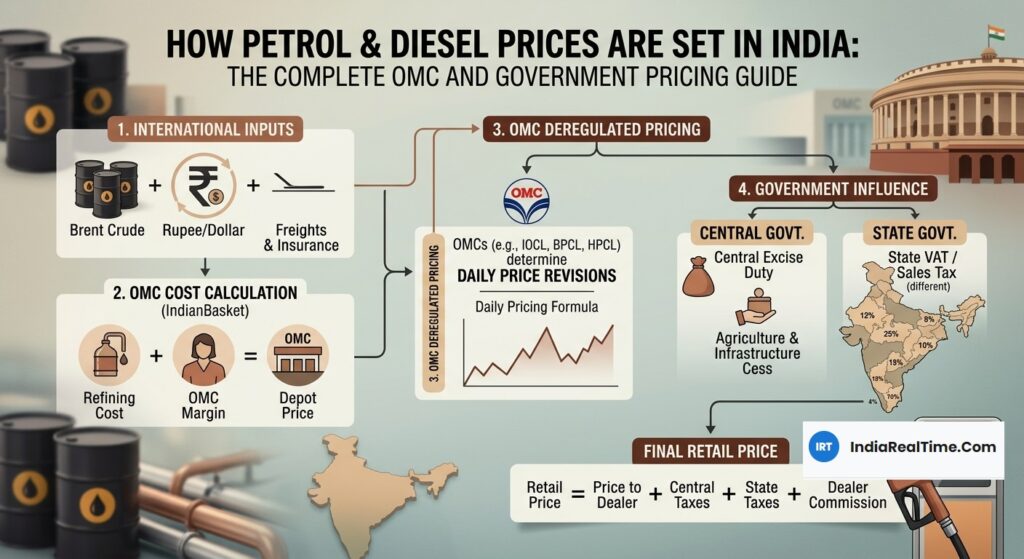
Petrol and diesel prices in India are determined under a dynamic pricing system where Oil Marketing Companies (OMCs) revise retail prices based on factors such as international crude oil prices, refinery costs, freight, dealer commissions, taxes, and the exchange rate between the Indian Rupee and the US Dollar. Retail prices are generally revised daily at 6:00 AM, although OMCs may choose to keep prices unchanged depending on market conditions and policy considerations.
Who Decides Petrol and Diesel Prices in India?
The responsibility for setting retail fuel prices primarily lies with India’s public sector Oil Marketing Companies (OMCs):
- Indian Oil Corporation (IOC)
- Bharat Petroleum Corporation Limited (BPCL)
- Hindustan Petroleum Corporation Limited (HPCL)
These companies review market conditions and determine retail selling prices under the dynamic pricing mechanism.
What Is Dynamic Fuel Pricing?
India adopted daily dynamic fuel pricing to align domestic fuel prices more closely with international market movements.
Instead of changing prices only occasionally, OMCs review market conditions regularly and revise prices when appropriate. Fuel prices are generally updated at 6:00 AM each day.
The Components of Petrol and Diesel Prices
Every litre of fuel sold at a petrol pump includes several cost components.
| Component | Purpose |
|---|---|
| International crude oil price | Cost of raw crude oil |
| Refining cost | Converting crude into petrol or diesel |
| Freight and transportation | Moving fuel to depots and pumps |
| OMC marketing margin | Operational and business costs |
| Dealer commission | Commission paid to fuel stations |
| Central taxes | Levied by the Union Government |
| State taxes (VAT) | Levied by individual states |
Because state taxes vary, petrol and diesel prices differ across India.
Step 1: International Crude Oil Prices
India imports a significant portion of its crude oil requirements.
When global crude oil prices increase:
- Refining becomes more expensive.
- Fuel procurement costs rise.
- Retail prices may increase if OMCs pass on higher costs.
Conversely, falling crude prices can create room for lower retail prices, though the extent depends on taxes and other factors.
Step 2: Refining the Crude Oil
Crude oil cannot be used directly in vehicles.
It must first be processed in refineries to produce:
- Petrol
- Diesel
- Aviation turbine fuel
- LPG
- Bitumen
- Other petroleum products
Refining costs form part of the overall price structure.
Step 3: Freight and Distribution Cost
After refining, fuel is transported through pipelines, railways, road tankers, and storage terminals before reaching petrol pumps.
Transportation costs vary depending on:
- Distance from refinery
- Distribution infrastructure
- Logistics expenses
These costs are included in the final retail price.
Step 4: Dealer Commission
Petrol pumps receive a fixed dealer commission for every litre sold.
This commission covers:
- Staff salaries
- Electricity
- Maintenance
- Equipment
- Operational expenses
Dealer commissions are included in the pump price.
Step 5: Government Taxes
Taxes are one of the largest components of retail fuel prices.
They generally include:
Central Government
The Union Government levies excise duties and other applicable central taxes.
State Governments
Each state imposes its own Value Added Tax (VAT) or similar levy.
Since VAT rates differ across states, fuel prices also differ from one state to another.
Why Petrol Prices Differ Between States
Even if the base fuel price is the same, consumers may pay different prices because of:
| Factor | Impact |
|---|---|
| State VAT | High |
| Local taxes | Moderate |
| Freight cost | Moderate |
| Dealer location | Low |
This is why petrol in one city may cost more than in another.
The Role of the Indian Rupee
Crude oil is traded globally in US Dollars.
If the Indian Rupee weakens against the Dollar:
- Imports become more expensive.
- Fuel procurement costs rise.
A stronger Rupee can help reduce import costs, although retail prices also depend on other factors.
Can the Government Control Fuel Prices?
Yes, governments can influence retail fuel prices in several ways, including:
- Adjusting central taxes.
- Changing import duties.
- Revising policy measures.
- Introducing temporary fiscal interventions.
OMCs also sometimes keep retail prices unchanged despite international market movements because of broader market and policy considerations.
How Often Do Fuel Prices Change?
Retail prices are generally reviewed every day.
However:
- Prices may remain unchanged for several days or weeks.
- OMCs may delay revisions during periods of unusual market volatility.
- Significant global events can lead to larger revisions when prices are updated.
Why Do Petrol and Diesel Prices Rise Even When Crude Falls?
Many people assume petrol prices should immediately decline when crude oil becomes cheaper.
In reality, retail prices depend on multiple factors:
- Existing inventories
- Exchange rates
- Taxes
- Freight costs
- OMC pricing decisions
- Government policies
As a result, retail prices do not always move in perfect sync with global crude prices.
Why Diesel Is Important to the Economy
Diesel powers much of India’s transportation and logistics network.
It is widely used by:
- Trucks
- Buses
- Agricultural machinery
- Construction equipment
- Goods transport
Changes in diesel prices can affect transportation costs and, indirectly, the prices of many goods and services.
Recent Fuel Price Revisions
Fuel prices continue to be influenced by international crude oil markets, exchange rates, and domestic policy decisions. In 2026, India also saw changes in export-related windfall taxes during periods of heightened global oil price volatility, highlighting how international events can influence the broader petroleum sector.
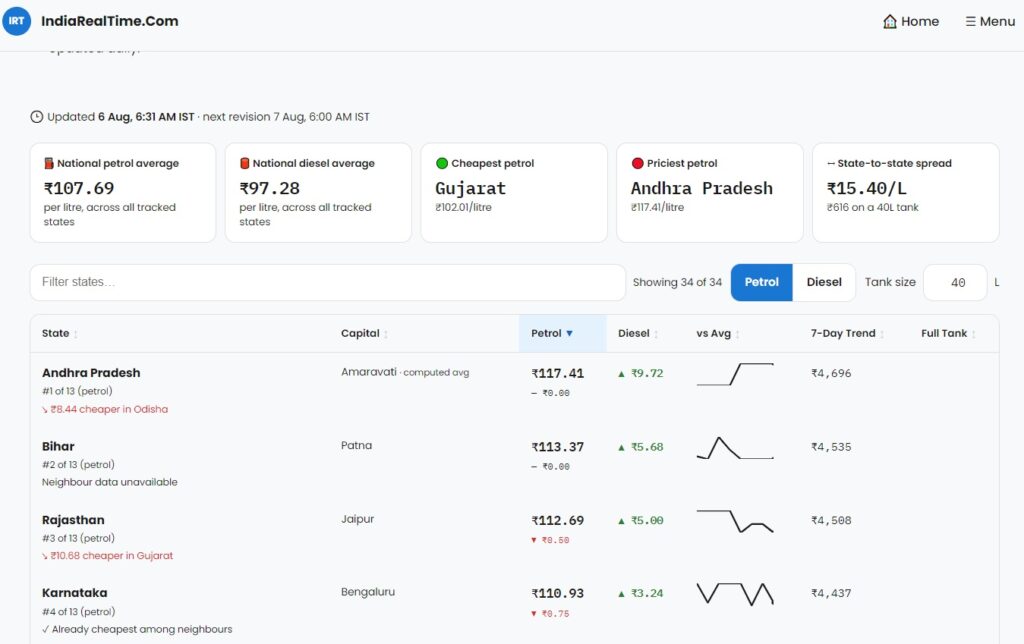
How IndiaRealTime Helps You Track Fuel Prices
Instead of searching multiple websites every morning, IndiaRealTime aims to make everyday information easier to access.
Along with fuel-related information, users can also check:
- Live weather
- Air Quality Index (AQI)
- Gold and silver prices
- Mandi commodity prices
- Daily Panchang
- Currency conversion
By bringing multiple services together in one place, users can quickly find the information they need before planning their day.
Frequently Asked Questions
Who decides petrol prices in India?
Retail petrol and diesel prices are determined by Oil Marketing Companies (OMCs) under the dynamic pricing mechanism, while government taxes and policies significantly influence the final consumer price.
Why are fuel prices different in every state?
State governments levy different VAT rates and taxes, resulting in different retail prices across states.
Are petrol prices updated every day?
Yes. Under the dynamic pricing system, prices are generally revised daily at 6:00 AM, although they may remain unchanged depending on market conditions.
Does India produce its own crude oil?
Yes, India produces some crude oil domestically but still imports a substantial share of its crude oil requirements.
Why are petrol and diesel prices affected by the US Dollar?
Crude oil is purchased in US Dollars. Exchange-rate movements directly influence India’s import costs.
Key Takeaways
- Petrol and diesel prices are determined by OMCs using a dynamic pricing system.
- Global crude oil prices, the Rupee-Dollar exchange rate, taxes, freight, and dealer commissions all contribute to the final retail price.
- State taxes are the primary reason fuel prices differ across India.
- Retail prices are generally reviewed daily at 6:00 AM.
- Understanding the price build-up helps consumers interpret why fuel prices rise or fall over time.
Conclusion
Petrol and diesel pricing in India is influenced by a combination of international markets, domestic taxation, logistics, and government policy. While crude oil prices receive the most attention, they are only one part of a larger pricing framework. You can track every city: Delhi, Bangalore all over india.
By understanding how OMCs calculate retail prices and how taxes, exchange rates, and distribution costs contribute to the final amount paid at the pump, consumers can better understand daily price movements. Platforms like IndiaRealTime further simplify access to everyday information, making it easier to stay updated on fuel prices alongside weather, AQI, commodity prices, and other essential daily data.

Want more like this?
Explore Fuel & Energy →