What Is Panchang? Complete Guide to Tithi, Nakshatra & Hindu Calendar
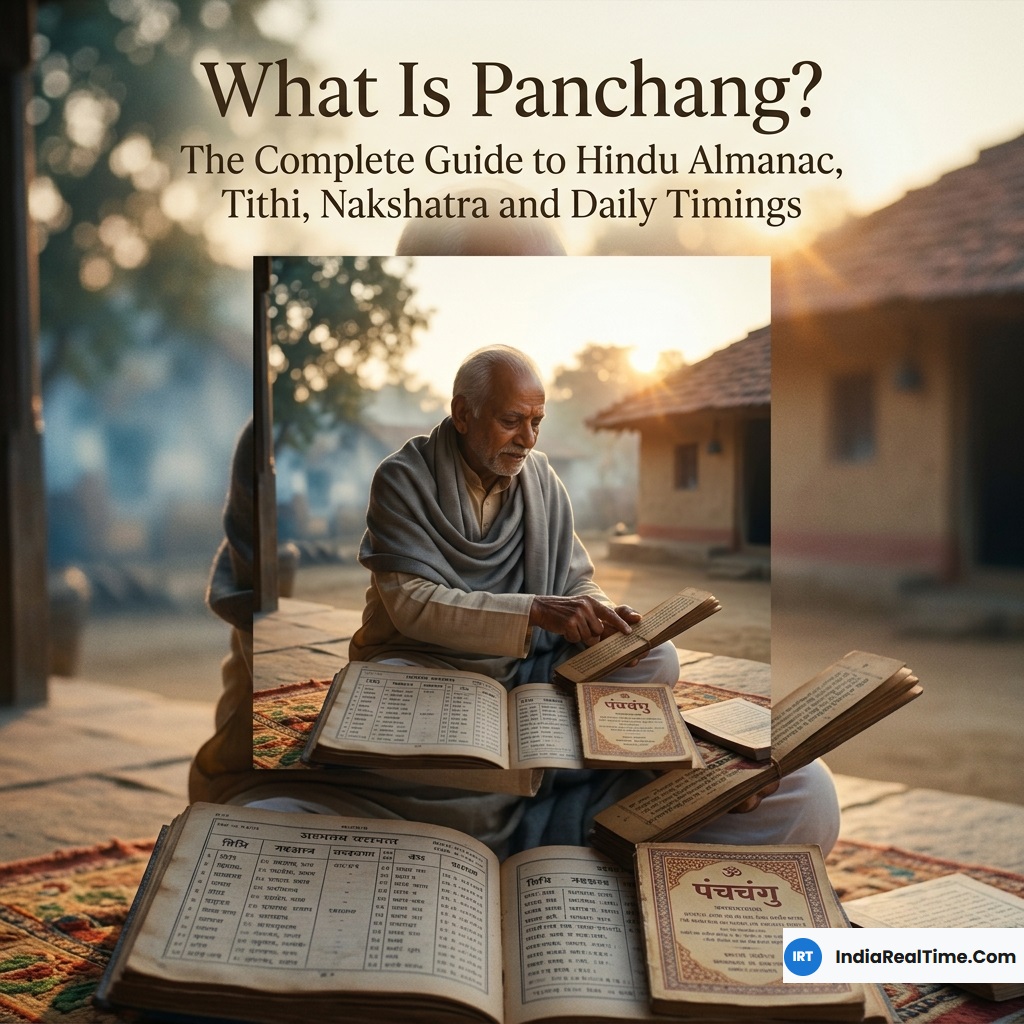
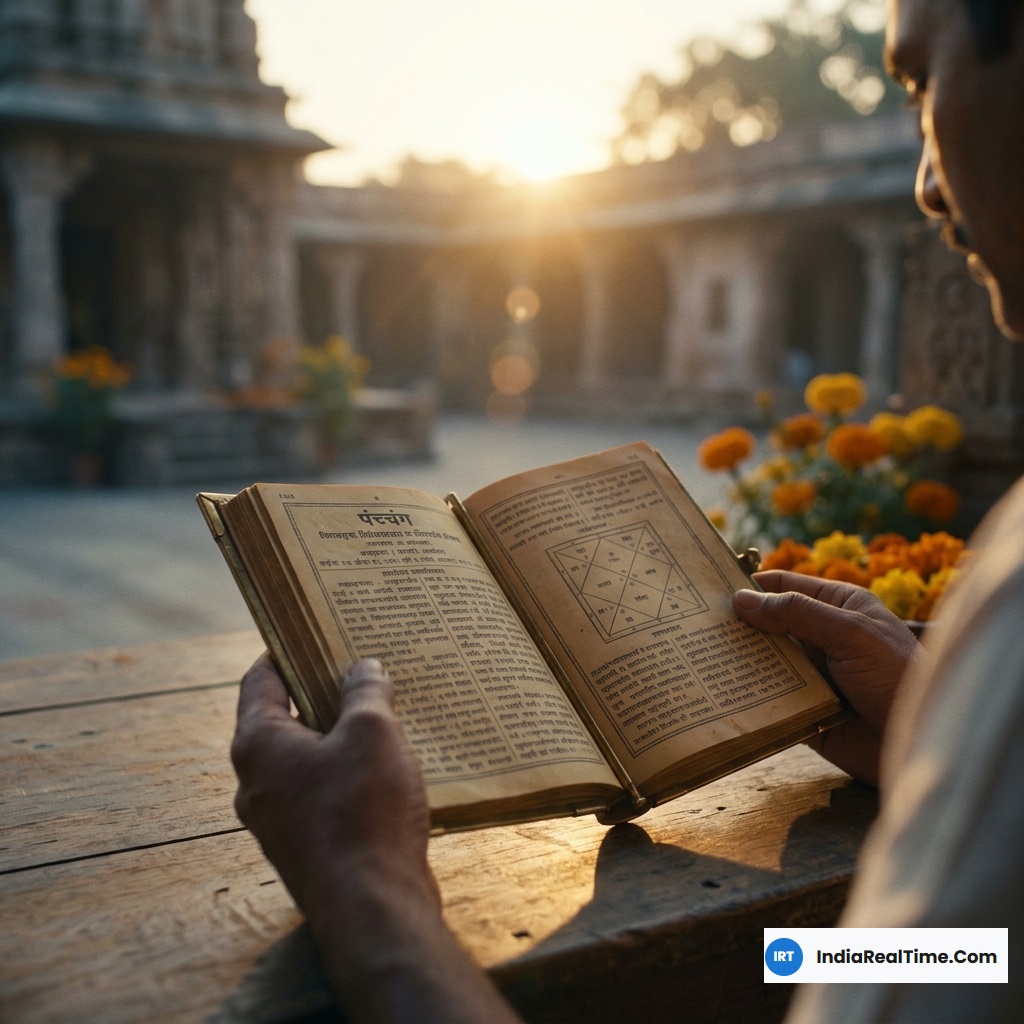
Panchang is a traditional Hindu almanac that provides astronomical, calendrical, and astrological information for a particular day and location. The word Panchang comes from Sanskrit and literally refers to the “five limbs” of the calendar:
- Tithi – lunar day
- Vara – weekday
- Nakshatra – lunar mansion
- Yoga – a calculation based on the positions of the Sun and Moon
- Karana – half of a Tithi
A daily Panchang may also provide sunrise and sunset, moonrise and moonset, Rahu Kalam, Yamaganda, Gulika Kalam, auspicious timings, festivals and other location-specific information.
The important point is that Panchang is location- and time-dependent. The Panchang for Delhi can differ from the Panchang for Kochi because sunrise, sunset and other astronomical timings depend on geographical location.
What Does the Word Panchang Mean?
The word Panchang is derived from two Sanskrit words:
- Pancha – five
- Anga – limbs or parts
The five fundamental components are therefore known as the five limbs of Panchang.
| Panchang Element | Meaning |
|---|---|
| Vara | Weekday |
| Tithi | Lunar day |
| Nakshatra | Lunar constellation/asterism |
| Yoga | Sun-Moon angular calculation |
| Karana | Half of a lunar day |
Together, these provide a traditional framework for describing a particular day.
Why Is Panchang Important?
Panchang has traditionally been used to understand the Hindu calendar and determine dates and timings for religious and cultural activities.
People may consult a Panchang when planning:
- Hindu festivals
- Puja
- Religious ceremonies
- Weddings
- Housewarming ceremonies
- Naming ceremonies
- Business openings
- Fasting days
- Temple activities
- Other traditional observances
Different communities and traditions may follow different rules for selecting an auspicious time, so a Panchang should be understood as a calendar and traditional timing system, rather than as a universal guarantee that an event will have a particular outcome.
The Five Main Parts of Panchang
1. Tithi: The Hindu Lunar Day
Tithi is one of the most important concepts in the Panchang.
A Tithi is determined by the angular relationship between the Sun and Moon. The lunar month is divided into 30 Tithis.
They are divided into two periods:
Shukla Paksha
The waxing phase of the Moon, from the new Moon toward the full Moon.
Krishna Paksha
The waning phase of the Moon, from the full Moon toward the new Moon.
Each Paksha contains 15 Tithis.
| Tithi | Traditional Name |
|---|---|
| 1 | Pratipada |
| 2 | Dwitiya |
| 3 | Tritiya |
| 4 | Chaturthi |
| 5 | Panchami |
| 6 | Shashthi |
| 7 | Saptami |
| 8 | Ashtami |
| 9 | Navami |
| 10 | Dashami |
| 11 | Ekadashi |
| 12 | Dwadashi |
| 13 | Trayodashi |
| 14 | Chaturdashi |
| 15 | Purnima / Amavasya |
The fifteenth Tithi is Purnima during the waxing half and Amavasya during the waning half.
Why Tithi Changes at Different Times
A common misconception is that one Tithi always corresponds to one complete calendar date.
That’s not necessarily the case.
A Tithi is based on the relative positions of the Sun and Moon rather than midnight-to-midnight civil time. Consequently, a Tithi can begin or end at any time of the day.
For this reason, a Panchang may show:
Tithi A until 2:15 PM, followed by Tithi B.
This is also why determining the correct date for a festival can require more than simply looking at the Gregorian calendar.
2. Vara: The Weekday
Vara refers to the weekday.
The seven Varas correspond to the seven days of the week:
| Sanskrit Name | English Day |
|---|---|
| Ravivara | Sunday |
| Somavara | Monday |
| Mangalavara | Tuesday |
| Budhavara | Wednesday |
| Guruvara | Thursday |
| Shukravara | Friday |
| Shanivara | Saturday |
Panchang calculations combine Vara with the other four limbs to describe the day.
3. Nakshatra: The Moon’s Position
Nakshatra refers to one of the 27 lunar divisions or asterisms used in traditional Indian astronomy and astrology.
The Moon moves through these divisions as it travels around the zodiac.
The 27 Nakshatras are:
- Ashwini
- Bharani
- Krittika
- Rohini
- Mrigashira
- Ardra
- Punarvasu
- Pushya
- Ashlesha
- Magha
- Purva Phalguni
- Uttara Phalguni
- Hasta
- Chitra
- Swati
- Vishakha
- Anuradha
- Jyeshtha
- Mula
- Purva Ashadha
- Uttara Ashadha
- Shravana
- Dhanishtha
- Shatabhisha
- Purva Bhadrapada
- Uttara Bhadrapada
- Revati
Each Nakshatra covers 13°20′ of the ecliptic.
Why Is Nakshatra Included in Panchang?
The Nakshatra indicates the Moon’s position within this traditional 27-part division.
Panchang users may consult it when determining:
- Festival timings
- Religious ceremonies
- Traditional muhurta
- Birth-related calculations
- Other cultural practices
In traditional astrology, Nakshatra has additional significance, but its interpretation depends on the specific astrological system being used.
4. Yoga: A Sun-Moon Calculation
Yoga is another component of Panchang.
It is calculated from the combined longitudinal positions of the Sun and Moon.
There are traditionally 27 Yogas.
Examples include:
- Vishkambha
- Priti
- Ayushman
- Saubhagya
- Shobhana
- Atiganda
- Sukarma
- Dhriti
- Shula
- Ganda
A Panchang identifies which Yoga is active at a particular time.
Traditional Panchang systems may associate different Yogas with different qualities or suitability for activities.
5. Karana: Half of a Tithi
A Karana represents half of a Tithi.
There are 11 Karanas in the traditional system, with four fixed Karanas and seven recurring Karanas.
The seven recurring Karanas are:
- Bava
- Balava
- Kaulava
- Taitila
- Garaja
- Vanija
- Vishti
The four fixed Karanas are:
- Shakuni
- Chatushpada
- Naga
- Kimstughna
Because a Tithi has two halves, Karanas change more frequently than Tithis.
Panchang Is More Than Five Elements
Although the name Panchang refers specifically to five components, a modern daily Panchang typically contains much more information.
A daily Panchang may include:
- Sunrise
- Sunset
- Moonrise
- Moonset
- Tithi
- Nakshatra
- Yoga
- Karana
- Vara
- Rahu Kalam
- Yamaganda
- Gulika Kalam
- Abhijit Muhurat
- Dur Muhurat
- Festivals
- Fasting information
- Lunar month
- Samvatsara
The exact information depends on the Panchang tradition and provider.
What Is Rahu Kalam?
Rahu Kalam is a daily period traditionally considered unsuitable for beginning certain auspicious activities in many Hindu traditions.
It occurs once each day, but its clock time changes depending on the weekday and local sunrise and sunset.
Importantly, Rahu Kalam is not a fixed time such as 1:30 PM every day.
Because it depends on the daylight period, location-specific Panchang calculations are necessary.
What Is Yamaganda?
Yamaganda is another period identified in traditional Hindu timekeeping.
Like Rahu Kalam, its timing varies according to the weekday and local daylight period.
Many people consult it when selecting timings for certain activities.
What Is Gulika Kalam?
Gulika Kalam, also called Gulika or Kuligai in some traditions, is another daily time period calculated from the day’s daylight hours.
It is included in many regional Panchang systems.
Its interpretation and use can vary between traditions.
What Is Muhurat?
A Muhurat is a traditionally selected period considered suitable for beginning a particular activity.
Different activities may have different criteria.
Examples include:
- Marriage
- Housewarming
- Starting a business
- Naming ceremonies
- Religious ceremonies
- Property-related activities
A Muhurat isn’t simply one universal “good time.” It is calculated according to the relevant traditional rules, date, location and activity.
Why Panchang Depends on Location
This is one of the most important things to understand about a daily Panchang.
Panchang is not completely identical across India on a given calendar date.
For example, sunrise in:
- Delhi
- Mumbai
- Kolkata
- Chennai
- Kochi
occurs at different local times.
That affects the calculation and presentation of various daily timings.
For accurate local information, users should therefore select their city or location when using an online Panchang.
Panchang and the Gregorian Calendar
India commonly uses the Gregorian calendar for civil purposes.
However, Hindu festivals and religious dates are often determined using traditional lunisolar calendar calculations.
This can create situations where a festival falls on a different Gregorian date from one year to another.
For example, festivals such as:
- Diwali
- Holi
- Janmashtami
- Navratri
- Raksha Bandhan
are linked to lunar dates and astronomical calculations rather than a fixed Gregorian date.
What Is a Hindu Lunar Month?
The Hindu calendar contains lunar months, with names such as:
- Chaitra
- Vaishakha
- Jyeshtha
- Ashadha
- Shravana
- Bhadrapada
- Ashwin
- Kartika
- Margashirsha
- Pausha
- Magha
- Phalguna
Different regional calendar traditions can use different conventions, including variations in how months begin and how an additional lunar month is handled.
What Is Adhik Maas?
Because lunar and solar cycles do not have exactly the same length, traditional lunisolar calendars periodically add an intercalary month, commonly called Adhik Maas.
This helps keep the lunar calendar broadly aligned with the solar year.
Adhik Maas is therefore an important concept when understanding why Hindu festival dates move relative to the Gregorian calendar.
How Is a Daily Panchang Calculated?
At a high level, Panchang calculations use astronomical positions and local geographical information.
A simplified process looks like this:
Astronomical calculations
↓
Sun and Moon positions
↓
Tithi + Nakshatra + Yoga + Karana
↓
Local sunrise/sunset and other timings
↓
Daily Panchang
The actual calculations can be considerably more complex because they depend on astronomical models, time zones, location coordinates and the particular Panchang tradition being followed.
Why Two Panchang Websites Can Show Different Results
Users sometimes notice differences between online Panchang services.
Possible reasons include:
- Different astronomical calculation methods
- Different ayanamsha conventions
- Different geographic coordinates
- Different sunrise definitions
- Regional calendar traditions
- Different festival rules
- Rounding or software differences
Therefore, when comparing Panchang information, it’s important to check whether both sources use the same methodology and location.
Panchang in Everyday Indian Life
Panchang remains relevant because it connects traditional calendar information with everyday planning.
A person might use it to check:
Morning
- Sunrise
- Tithi
- Nakshatra
During the day
- Rahu Kalam
- Yamaganda
- Muhurat
For the evening
- Sunset
- Moonrise
- Festival or religious timings
This makes Panchang both a calendar and a daily reference system for people who follow these traditions.
How IndiaRealTime Can Make Panchang Easier to Access
Traditional Panchang information can be overwhelming for someone unfamiliar with the terminology.
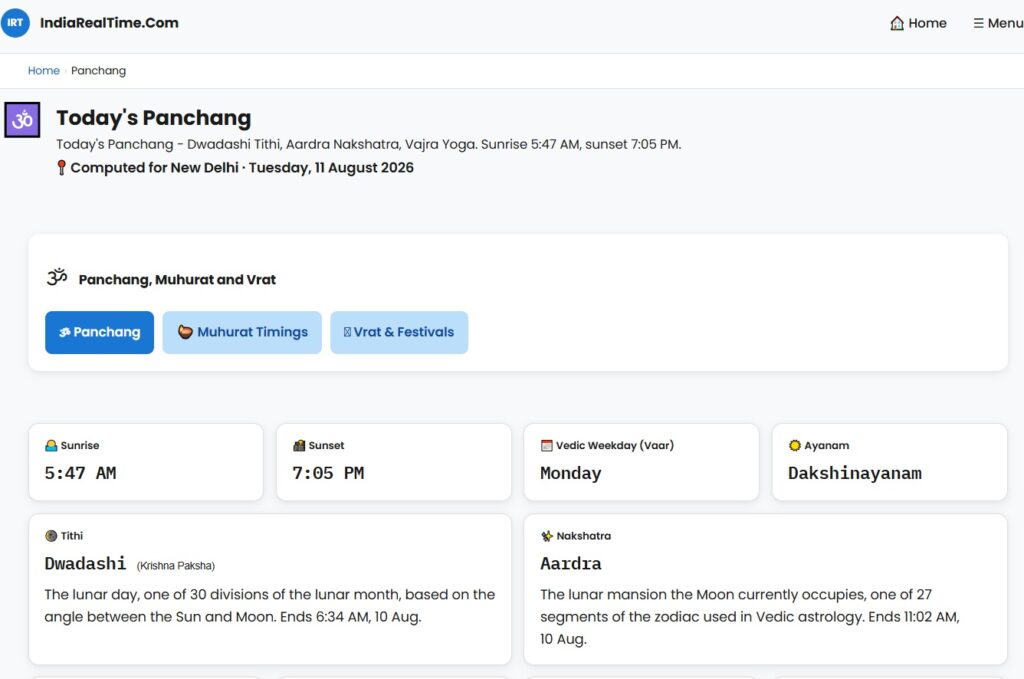
IndiaRealTime can make the experience simpler by presenting daily Panchang information alongside other location-specific information such as:
- Weather
- AQI
- Gold prices
- Silver prices
- Mandi prices
- Petrol Price
- Currency conversion
This creates a useful daily information dashboard.
The daily Panchang figures shown on IndiaRealTime are computed via FreeAstrologyAPI.com and refreshed once a day — see our Data Methodology page for the full sourcing and refresh schedule of every dataset on the site.
For example, a user preparing for a religious event can check:
- Today’s Panchang
- Sunrise and sunset
- Local weather
- AQI
- Gold prices if jewellery is being purchased
Instead of opening several websites, the user can access these everyday details from one place.
Is Panchang the Same as a Horoscope?
No.
Panchang and horoscope are related to traditional Indian astronomical/astrological systems, but they serve different purposes.
Panchang
Primarily provides calendar and daily astronomical information.
Horoscope / Janam Kundli
Uses a person’s birth date, time and location to create an astrological chart.
A Panchang tells you about the day and its traditional time divisions.
A horoscope is based on an individual’s birth information.
Frequently Asked Questions
What are the five parts of Panchang?
The five primary parts are Tithi, Vara, Nakshatra, Yoga and Karana.
What is today’s Tithi?
Today’s Tithi depends on the current date, time and location. It should be calculated using a current Panchang rather than assumed from the Gregorian date alone.
Why does Tithi change during the day?
Because Tithi is determined by the angular relationship between the Sun and Moon, it does not necessarily align with midnight-to-midnight calendar days.
How many Nakshatras are there?
Traditional Panchang systems use 27 Nakshatras, each spanning 13°20′.
Why is location important for Panchang?
Sunrise, sunset, moonrise and other local timings depend on geographical location. Consequently, daily Panchang timings can differ between cities.
Is Panchang scientifically proven to predict future events?
Panchang’s astronomical calculations describe positions and cycles of celestial bodies. Astrological interpretations and claims about future outcomes are matters of traditional belief, not established scientific predictions.
Key Takeaways
- Panchang is a traditional Hindu almanac.
- The name refers to its five principal components: Tithi, Vara, Nakshatra, Yoga and Karana.
- Tithi is based on the angular relationship between the Sun and Moon.
- Nakshatra describes the Moon’s position within a traditional 27-part division.
- Yoga is calculated from the combined positions of the Sun and Moon.
- Karana represents half of a Tithi.
- Daily Panchang may also include Rahu Kalam, Yamaganda, Muhurat, sunrise, sunset, moonrise and festivals.
- Panchang information is location-dependent, so selecting the correct city matters.
- Regional traditions can produce differences in festival dates and interpretations.
- Panchang is a calendar and traditional timing system; its astrological interpretations should be distinguished from scientifically established claims.
Conclusion
Panchang is much more than a traditional calendar.
It is a detailed system for describing lunar days, lunar positions, weekdays, astronomical combinations and daily timings within Hindu calendrical traditions.
Understanding its five core elements! Tithi, Vara, Nakshatra, Yoga and Karana! makes the daily Panchang much easier to read. Additional information such as Rahu Kalam, Muhurat, sunrise, sunset and festival dates adds practical value for people who follow these traditions.
In the digital age, Panchang has also become easier to access. Platforms such as IndiaRealTime can bring daily Panchang information together with weather, AQI, gold prices, mandi rates and currency conversion, creating a convenient location-based resource for everyday life.
The key is to remember that Panchang is location-sensitive and tradition-specific. For important religious dates or ceremonies, users should check a reputable Panchang source and, where relevant, follow the customs of their family, community or religious tradition.
Want more like this?
Explore Panchang & Culture →